Ever stared at a blank character sheet, wondering what to call your samurai? Or maybe you’re hunting for a surname that honors your Japanese roots. It’s tricky when you can’t tell which names are real, common, or just cool.
This list gives you 620+ Japanese family names sorted by theme, region, and vibe. You’ll also get quick history, meanings, and tips for choosing one that fits your story, game, baby name idea, or family tree.
Most Popular Japanese Last Names
These are the common Japanese surnames you’ll hear again and again in Japan. Sato and Suzuki sit near the top of most lists, and Takahashi and Tanaka aren’t far behind. They’re easy to say, easy to spell, and a safe pick for any story.
- Sato
- Suzuki
- Takahashi
- Tanaka
- Watanabe
- Ito
- Yamamoto
- Nakamura
- Kobayashi
- Kato
- Yoshida
- Yamada
- Sasaki
- Yamaguchi
- Matsumoto
- Inoue
- Kimura
- Hayashi
- Shimizu
- Yamazaki
- Mori
- Abe
- Ikeda
- Hashimoto
- Ishikawa
- Ogawa
- Goto
- Okada
- Hasegawa
- Murakami
How Japanese Last Names Work
In Japan, the family name comes first, then the given name. So you’d say Tanaka Hiro, not Hiro Tanaka. Most names are written in kanji, and each character carries a meaning. Tanaka, for example, means “in the rice field.”
Many surnames come from land, water, and plants. That’s why you’ll see so many mountains, rivers, fields, and trees below.
History of Japanese Surnames
Long ago, only nobles, warriors, and powerful clans used surnames. Everyday people often went by a given name plus a place or job.
That changed in the 1870s, during the Meiji era. The government asked every citizen to pick a family name. People chose names from their villages, rice fields, bridges, and trees. This is why Japan now has tens of thousands of surnames, and some estimates run far higher.
Japanese Last Names With Dark Meanings
Picture a villain in your novel. You want a name that feels shadowy but is still real. These use kanji for black, shadow, or demon. They sound intense, but they’re just ordinary place-based names in Japan.

- Kuroda
- Kurosawa
- Kuroki
- Kurokawa
- Kuroiwa
- Kuronuma
- Kuroyama
- Kurosaki
- Kurobe
- Kuroshima
- Kurotani
- Kurohara
- Kuroyanagi
- Kurosu
- Kageyama
- Kagemori
- Onizuka
- Onitsuka
- Onizawa
- Kageura
Common Japanese Surnames and Meanings
Knowing what a name means makes it easier to remember. Here are Japanese surnames and meanings you can use right away.
- Kondo (near the wisteria)
- Ishii (stone well)
- Aoki (green tree)
- Fujii (wisteria well)
- Nishimura (west village)
- Fukuda (lucky rice field)
- Ota (big field)
- Miura (three bays)
- Fujita (wisteria field)
- Matsuda (pine field)
- Nakagawa (middle river)
- Nakano (middle field)
- Harada (meadow field)
- Ono (small field)
- Tamura (rice field village)
- Takeuchi (inside the bamboo)
- Wada (peaceful field)
- Nakayama (middle mountain)
- Ishida (stone field)
- Ueda (upper field)
- Morita (forest field)
- Hara (plain)
- Shibata (brushwood field)
- Sakai (boundary)
- Kudo (craftsman of wisteria)
- Kaneko (gold child)
- Sakamoto (foot of the slope)
- Endo (distant wisteria)
- Koike (small pond)
- Okamoto (base of the hill)
Nature Inspired Japanese Surnames
Nature is the biggest source of Japanese surnames. If you love calm, earthy, and pretty sounds, start here.
Mountain and Sky Names
- Takayama
- Yamashita
- Yamaoka
- Yamagishi
- Yamanaka
- Yamauchi
- Yamane
- Mineta
- Minegishi
- Miyama
- Oyama
- Koyama
- Fukuyama
- Iwayama
- Matsuyama
- Amano
- Amakawa
- Kumoi
- Hoshino
- Hoshikawa
- Tsukiyama
- Asahina
- Asahi
- Sorano
- Tsukino

River and Water Names
- Kawaguchi
- Kawamura
- Kawasaki
- Kawada
- Kawai
- Kawano
- Kawabata
- Kawakami
- Kawashima
- Mizuno
- Mizutani
- Mizusawa
- Mizukami
- Ikegami
- Ikeuchi
- Umino
- Hamada
- Hamaguchi
- Hamasaki
- Hamamoto
- Isozaki
- Isobe
- Minato
- Numata
- Sawada
Forest and Flora Names
- Morimoto
- Moriyama
- Morishita
- Morioka
- Morimura
- Takeda
- Matsushita
- Matsuoka
- Matsui
- Sugiyama
- Sugimoto
- Sugawara
- Sugita
- Yanagida
- Yanagawa
- Sakurai
- Sakuragi
- Sakurada
- Umemoto
- Kikuchi
- Hagiwara
- Fujimoto
- Hayashida
- Tsubaki
- Takenaka
Regional Japanese Last Names
Some names are linked to certain parts of Japan. If your character is from a specific area, this makes the name feel real. Keep in mind that many names spread across the country over time, so these are tendencies, not strict rules.
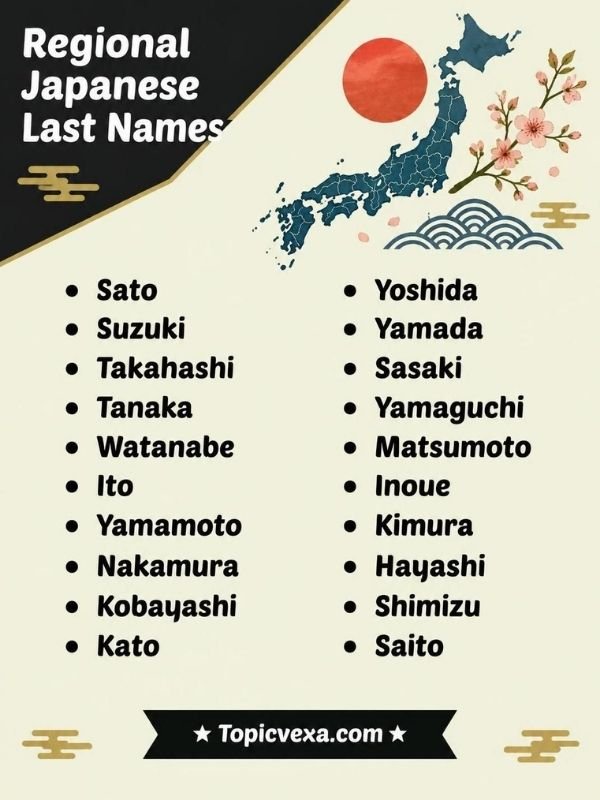
Names from Eastern Japan (Kanto and Tohoku)
The east has cold winters and old castle towns. Names like Ichinohe, Ninohe, and Sannohe come from the northern Tohoku area.
- Chiba
- Konno
- Satake
- Nambu
- Date
- Mogami
- Hojo
- Tsugaru
- Akita
- Aizawa
- Ichinohe
- Ninohe
- Sannohe
- Hachinohe
- Kamakura
- Utsunomiya
- Takasaki
- Sano
- Kasai
- Hirose
- Yuki
- Oyamada
- Nasu
- Satomi
- Chichibu
Names from Western Japan (Kansai and Chugoku)
The west holds Kyoto, Osaka, and a lot of samurai history. Many of these names still ring with that old-city feel.
- Kyogoku
- Hyodo
- Asano
- Ikoma
- Mouri
- Kikkawa
- Kobayakawa
- Amago
- Ouchi
- Yamana
- Akamatsu
- Miyoshi
- Hosokawa
- Tsutsui
- Yagyu
- Hirano
- Tanabe
- Nakai
- Kataoka
- Okuda
- Higashiyama
- Kishida
- Kuwabara
- Wakisaka
- Tsujimoto
Names from Southern Japan (Kyushu and Okinawa)
Okinawan names sound different from mainland ones, with short, open sounds. Kyushu names often come from old warrior houses.
- Shimazu
- Nabeshima
- Otomo
- Ryuzoji
- Sagara
- Arita
- Higa
- Kinjo
- Miyagi
- Oshiro
- Shimabukuro
- Tamaki
- Chinen
- Uehara
- Arakaki
- Kuniyoshi
- Teruya
- Toma
- Gushiken
- Uechi
- Kyan
- Nakasone
- Yonamine
- Agena
- Ginoza
Famous Japanese Names From Literature and Games
Want a name that fans will spot right away? These are pop-culture references from anime, manga, games, and books, plus two real authors. They’re fun for gaming tags and fan projects, but they come with built-in expectations.
- Uchiha
- Uzumaki
- Hatake
- Himura
- Kamiya
- Yagami
- Kirigaya
- Emiya
- Tohsaka
- Kamado
- Agatsuma
- Kocho
- Gojo
- Fushiguro
- Itadori
- Zenin
- Inumaki
- Kazama
- Mishima
- Hayabusa
- Akutagawa
- Natsume
Male Japanese Last Names
Japanese surnames aren’t split by gender, so any of these can be used by anyone. Still, some just sound strong and sharp, which is why writers like them for male leads.
- Takagi
- Takamori
- Takashima
- Takano
- Takata
- Takai
- Tsurugi
- Washio
- Washizu
- Torii
- Toyama
- Tomita
- Tominaga
- Tomioka
- Daimon
- Daigo
- Goda
- Gondo
- Gonda
- Banno
- Bando
- Ishiguro
- Ishihara
- Iwasaki
- Iwata
- Iwamoto
- Kajiwara
- Kanemoto
- Kurata
- Ogura
Female Japanese Last Names
Again, surnames are shared by everyone. These just lean soft, floral, and melodic, with sounds like “hana” (flower) and “shira” (white).
- Himeno
- Hanazono
- Hanada
- Hanai
- Hanaoka
- Haruno
- Harukawa
- Hinata
- Kasumi
- Sayama
- Shiraishi
- Shirakawa
- Shiratori
- Shirogane
- Shiraki
- Shiina
- Shiozaki
- Shinohara
- Shinozaki
- Suzumura
- Suzukawa
- Tsukimori
- Tsukishima
- Asakura
- Ayase
- Ayakawa
- Hoshina
- Mizuhara
- Nanase
- Narumi
Cool and Unique Japanese Last Names
Want something rare that still looks real on paper? These are unique Japanese last names with a stylish edge. Imagine your gaming duo seeing one of these on a scoreboard. Hard to forget, right?
- Kamishiro
- Kirishima
- Kisaragi
- Tsukumo
- Yatsuhashi
- Hyakutake
- Nanjo
- Mikazuki
- Shinonome
- Tatsumi
- Tatsuno
- Ryugasaki
- Ryuzaki
- Sumeragi
- Ogami
- Hiiragi
- Kagurazaka
- Kazamatsuri
- Shishido
- Amamiya
- Kurebayashi
- Mikami
- Mitsuki
- Fuwa
- Saotome
- Sakaguchi
- Sagisawa
- Todoroki
- Tokisaki
- Wakamatsu
- Yakumo
- Yaegashi
- Yatabe
- Shiranui
- Narukami
- Onodera
- Mutsuki
- Hazuki
- Kanzaki
- Kuonji
Warrior and Samurai Japanese Last Names
These are tied to famous samurai clans and war lords. Real history comes with them, so they carry weight in a story.
- Oda
- Tokugawa
- Toyotomi
- Uesugi
- Imagawa
- Maeda
- Hattori
- Sanada
- Chosokabe
- Miyamoto
- Kusunoki
- Ashikaga
- Hatakeyama
- Akechi
- Sakakibara
- Honda
- Ukita
- Matsudaira
- Sakuma
- Niwa
- Kuki
- Rokkaku
- Yamanouchi
- Itagaki
- Inaba
- Hachisuka
- Ogasawara
- Anayama
- Nagao
- Shinmen
Royal and Noble Japanese Last Names
These come from the imperial court and noble houses of old Kyoto. Minamoto and Taira were real rival clans from Japan’s history. The Fujiwara family held huge power at court for centuries.
- Fujiwara
- Minamoto
- Taira
- Tachibana
- Soga
- Kujo
- Konoe
- Ichijo
- Nijo
- Takatsukasa
- Reizei
- Saionji
- Sanjo
- Tokudaiji
- Kazanin
- Ogimachi
- Nakamikado
- Madenokoji
- Arisugawa
- Fushimi
- Kitashirakawa
- Yamashina
- Asukai
- Rokujo
- Karasumaru
Traditional and Classic Japanese Last Names
Looking for a name that feels timeless and neat? These traditional Japanese surnames are steady, familiar, and easy to pronounce.
- Nakajima
- Nagata
- Nagai
- Nagano
- Nagasaki
- Nishida
- Nishiyama
- Nishikawa
- Nishino
- Noguchi
- Nomura
- Noda
- Ohashi
- Okamura
- Okazaki
- Okuyama
- Ozawa
- Sakata
- Shimada
- Shimura
- Sugiura
- Suda
- Taniguchi
- Tsuchiya
- Uchida
- Ueno
- Ushijima
- Furukawa
- Fukui
- Fukushima
Japanese Names Inspired by Other Cultures
Japan has a long history of contact with Korea and China. Some surnames trace back to migrant families who settled long ago. Names like Hata, Kudara, and Koma are linked to those groups, and the “Kara” names often point to the Asian mainland. Scholars still debate some of these links, so treat them as traditional connections.
- Hata
- Hatano
- Kudara
- Koma
- Shiragi
- Karasawa
- Karakida
- Karahashi
- Karatsu
- Karaki
- Ayabe
- Karakawa
- Karayama
- Karaoka
- Hatanaka
- Hatae
- Komano
- Komai
Japanese Naming Traditions and Lore
A few fun facts to know before you pick. Women in Japan usually take their husband’s family name after marriage, since Japanese law asks a married couple to share one surname. Family crests, called mon, also tied clans to their names. And some names are written with rare kanji, so even native speakers sometimes ask, “How do you read that?”
Tip: always check the kanji when you can. The same sound can be written many ways, with different meanings.
Japanese Last Names Easy for English Speakers to Say
Tired of people butchering the name? These are short, clear, and friendly for an American tongue.
- Aida
- Ando
- Arai
- Baba
- Doi
- Eto
- Hori
- Imai
- Kono
- Kubo
- Kida
- Mano
- Mita
- Nishi
- Oka
- Oki
- Sada
- Seki
- Tago
- Tani
- Tada
- Toda
- Tsuda
- Uno
- Hino
- Kita
- Mito
- Nitta
- Obata
- Oishi
Japanese Surnames From Jobs, Boats, Rice Fields and Lucky Animals
Many Japanese surnames come from daily life. Think rice fields, fishing boats, and storehouses. Cranes and turtles show up too, since both stand for long life.
- Ueki
- Ukai
- Kaji
- Kanaya
- Kuramoto
- Kurahashi
- Kurasawa
- Funakoshi
- Funaki
- Funabashi
- Funatsu
- Funada
- Inagaki
- Inamura
- Inatomi
- Inada
- Inagawa
- Iwai
- Kuwata
- Kuwano
- Kameda
- Kamei
- Kamata
- Tsurumi
- Tsuruta
- Tsuruoka
- Hiraoka
- Hirata
- Hiraga
- Hirai
Japanese Last Name Ideas Based on Colors and Numbers
Colors and numbers give surnames a clean, simple look. Think “ao” (blue or green), “aka” (red), “shiro” (white), and “mitsu” (three).
- Akagi
- Akai
- Akaike
- Akazawa
- Akabane
- Akamine
- Aoyama
- Aoyagi
- Aosawa
- Aoshima
- Midorikawa
- Shirai
- Shirota
- Shiroyama
- Shiromoto
- Shirasaka
- Ichikawa
- Ichihara
- Nikaido
- Nimura
- Mitsui
- Mitani
- Mikawa
- Yotsuya
- Itsuki
- Rokugo
- Nanami
- Yaguchi
- Kokonoe
- Totsuka
Japanese Last Names for Girls With a Bright, Cute Feel
If you’re naming a girl character, pen name, or online persona, try these. They’re cute, light, and easy on the ear, with a lot of peach, snow, and princess sounds.
- Momose
- Momoi
- Momoki
- Himekawa
- Himejima
- Himuro
- Yukishiro
- Yukimura
- Yukino
- Yukita
- Mikuni
- Mayama
- Maeno
- Maruyama
- Marui
- Kasugai
- Kasahara
- Kozuki
- Kotani
- Konishi
- Kobato
- Kisaki
- Mashiro
- Otowa
- Orihara
- Hanamura
- Hanabusa
- Hanamoto
- Hanayama
- Hoshizaki
Japanese Family Names Tied to Places and Landmarks
Shrines, temples, bridges, and gates all became Japanese family names. These paint a picture of a village you could walk through.
- Kobashi
- Hashizume
- Hashiguchi
- Kadowaki
- Kadota
- Kadono
- Miyazaki
- Miyata
- Miyake
- Miyajima
- Miyauchi
- Miyashita
- Miyahara
- Miyagawa
- Jinno
- Jingu
- Teramoto
- Terada
- Terai
- Terasawa
- Terauchi
- Shimamura
- Shimamoto
- Shimokawa
- Shimoda
- Shimomura
- Ishibashi
- Ishizaka
- Ishizuka
- Ishimura
Japanese Clan Names and Compound Surnames
Clan names are the oldest layer of Japanese surnames. Some, like Mononobe and Nakatomi, belong to ancient court families. Others, like the “Kita” (north) and “Higashi” (east) names, simply join two meanings together.
- Kitagawa
- Kitamura
- Kitajima
- Kitano
- Kitamoto
- Higashikawa
- Higashino
- Minamikawa
- Minamino
- Mononobe
- Nakatomi
- Inbe
- Wani
- Kamo
- Aso
- Hozumi
- Izumo
- Kibi
- Sakanoue
- Tajihi
- Oe
- Mibu
- Imibe
- Kasuga
- Munakata
- Hachiya
- Mikoshiba
- Suwa
- Tsugawa
- Tsuzuki
How to Pick the Best Japanese Last Name
A great name matches the job you need it to do. Ask yourself a few things:
- Purpose: Is it for a book, a game, a baby, or a username?
- Mood: Do you want calm (Mizuno), strong (Tokugawa), or mysterious (Kageyama)?
- Length: Short names like Doi are great for chat. Longer ones like Kitashirakawa feel grand.
- Say it out loud: If you stumble over it, readers will too.
- Pair it well: Try it with a given name. Some combos flow, others clash.
Quick Naming Check
Run through this list before you lock it in.
- Is it spelled the right way, in romaji and kanji?
- Does it fit the character’s region and background?
- Can your audience say it without help?
- Is it unique among the names in your story?
- Does the meaning match the mood you want?
Common Mistakes to Avoid
Don’t mash random sounds together and call it Japanese. Real names follow patterns. Also, skip famous names like Tokugawa for ordinary characters unless you mean it. And don’t treat a pop-culture name as a blank slate, since fans will notice.
One more thing: don’t flip the order. Family name first, given name second.
Frequently Asked Questions
What are rare Japanese last names?
Rare ones include Kamishiro, Hyakutake, Yatsuhashi, Kuonji, and Tsukumo. Many have few families carrying them, which makes them stand out in any setting.
What are good Japanese last names?
The best pick depends on your goal. For a smooth, easy name, try Aida, Ando, or Mizuno. For a bold one, try Kirishima, Ryuzaki, or Takagi.
What is an old Japanese last name?
Clan names like Mononobe, Nakatomi, Fujiwara, and Minamoto are among the oldest. They go back to ancient courts and powerful families.
What are the 100 most common Japanese surnames?
Sato, Suzuki, Takahashi, Tanaka, Watanabe, Ito, Yamamoto, Nakamura, and Kobayashi lead most rankings. You’ll find dozens more in the popular and common sections above. Exact rankings shift by source and year.
Conclusion
You’ve got 620+ Japanese last names to explore, from simple classics to rare gems with real history. Pick the mood first, check the meaning, and say it out loud before you decide.
Whether it’s for a story, a game, or your own family research, the right Japanese family name makes everything feel more real. Which one caught your eye? Share your favorite in the comments.
Daniel Carter is a professional content writer and researcher at TopicVexa. He creates clear, engaging, and informative content across a wide range of topics, with a focus on accuracy, simplicity, and reader value.